How to Teach Kids Knife Skills Safely: A First Lesson for Parents and Instructors
Introduction to Kid-Safe Knife Skills
For many parents, the idea of handing their child a knife feels nerve-wracking and anxiety-inducing. Yet avoiding knives altogether does not teach a child how to handle one safely. With an appropriate tool, manageable food, close supervision, and clear instruction, children can begin developing the habits they will need later.
A safety reminder before we start: There should always be an adult supervising, and children should not be left alone in the kitchen. Everything in this post assumes that supervision is paramount. The age ranges below are starting points, not rules – a child’s actual readiness depends on maturity, ability to follow directions, attention, and coordination.
This article focuses on choosing an appropriate tool and teaching a child’s first cutting lesson. Before you begin, review the essential knife-safety habits children need to learn first.
Why Kids Should Learn Knife Safety Early
Properly handling a knife is a fundamental life skill. Every chef started with learning how to respect his or her tools first. Then, through much practice, they mastered chopping and dicing.
The key is starting early and safely.
Right now, we are focusing on safety for eager young chefs who may not have the dexterity for chopping or dicing.
This guide is for safety-minded parents who want their children to learn real kitchen skills with confidence. I’m sharing the tools, tips, and teaching strategies I have used as a kids cooking instructor working with children of different ages and abilities. It is also a helpful resource for grandparents, homeschool families, Montessori educators, and instructors who are building or growing their own kids cooking programs.
Many people assume knife practice belongs in the preteen years. In my experience, children who learn safe cutting techniques early become calmer, more engaged cooks later.
For children ages 3 to 7, early knife practice can help:
- Develop fine motor skills
- Improve hand-eye coordination while practicing a proper grip
- Teach them to slow down and focus
- Build real confidence in the kitchen
One of the biggest safety lessons children learn is that sharp tools require calm bodies. Keeping children safe does not always mean removing every risk. It means controlling the environment, choosing an appropriate tool and manageable food, staying close enough to supervise, and adding responsibility gradually. Children do not have to wait until a certain birthday to begin learning—but they do need an adult who understands what they are ready to handle.
This is the idea behind managed risk. Research on children’s risky play supports allowing developmentally appropriate challenges instead of removing every possible risk, although that research does not specifically address kitchen knives (Brussoni et al., 2012). Cooking-specific research supports the same gradual approach: begin with child-safe tools and easier foods, then introduce sharper knives and more challenging foods as the child gains strength, confidence, and proficiency (Dean et al., 2021).
“Teaching knife skills is risky.”
Reality: Not teaching safe habits early is riskier.
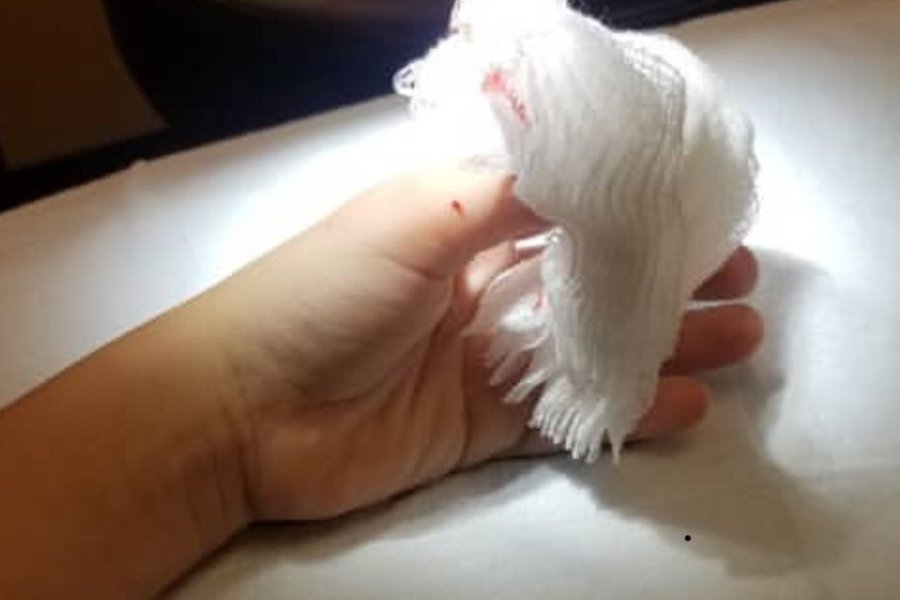
Foundations of Safety, Before Any Knife Is Introduced
Before a child ever picks up a knife, they should see an adult demonstrate calm, controlled technique: a clean steady workspace, the Bear Claw Grip with the guiding hand, and pinch the blade for control.
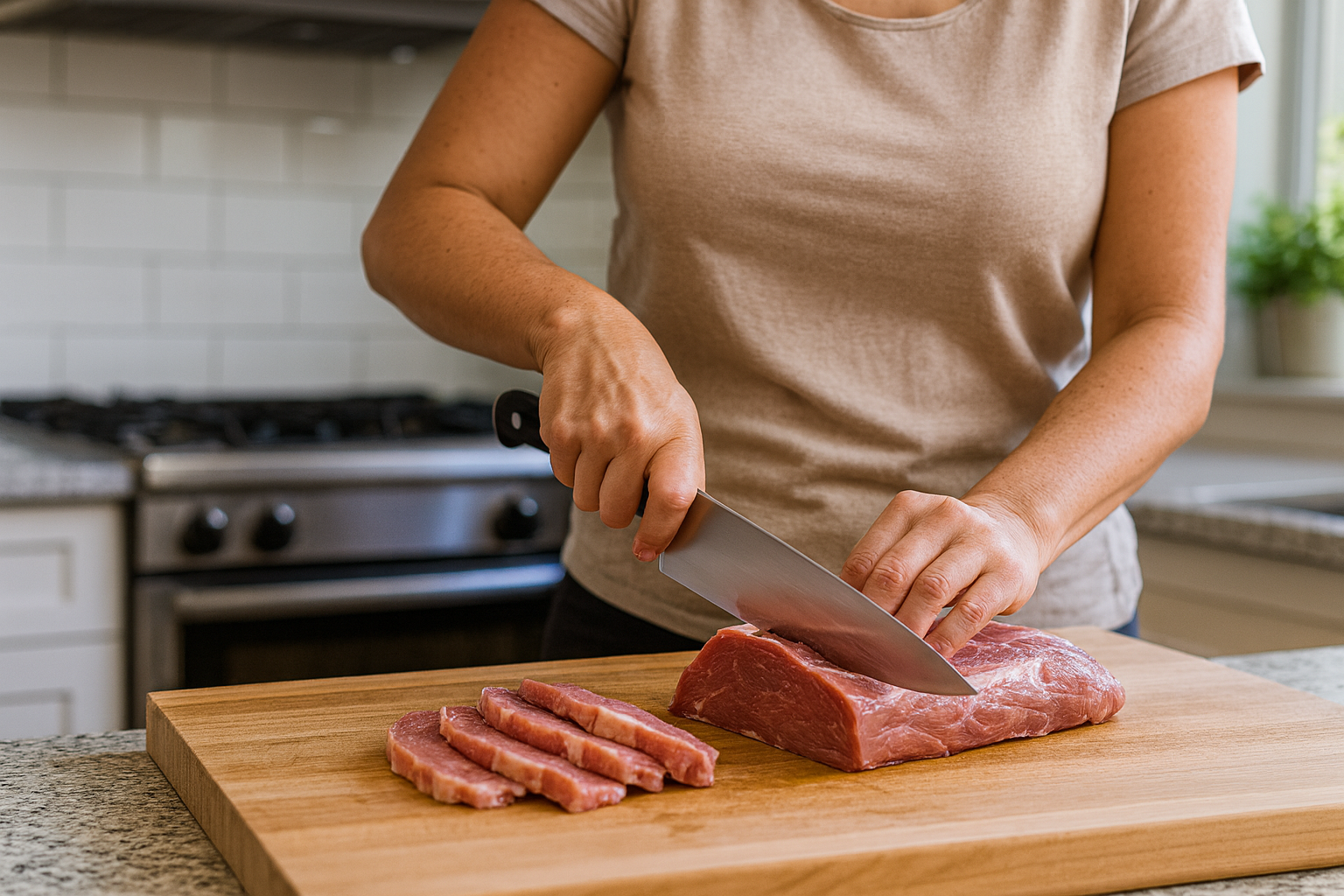
Kids imitate what they see. Modeling safe behavior is more important than the specific knife you hand them.
Age-Based Tool Progression
Practice Tools: A First Stage for Young Beginners
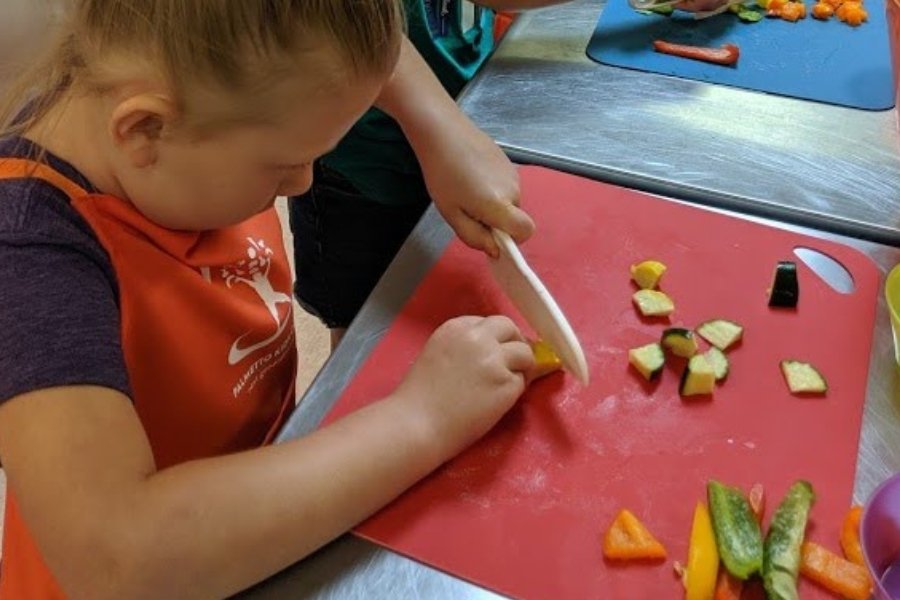
Some children around ages 3–5 may be ready to begin cutting easy foods with child-safe, plastic, or butter-style knives under extremely close adult supervision. The child’s readiness and the tool’s actual cutting ability matter more than the age printed on a package.
Do not assume that every plastic knife is safe simply because it is marketed to children. Test the tool yourself with the food you plan to use. If it bends, slips, requires excessive pressure, or encourages forceful sawing, choose a different tool or softer food.
Ideal beginner tools include:
- Nylon safety knives
- Food-safe wavy vegetable choppers
- Non-slip cutting mat to keep everything stable
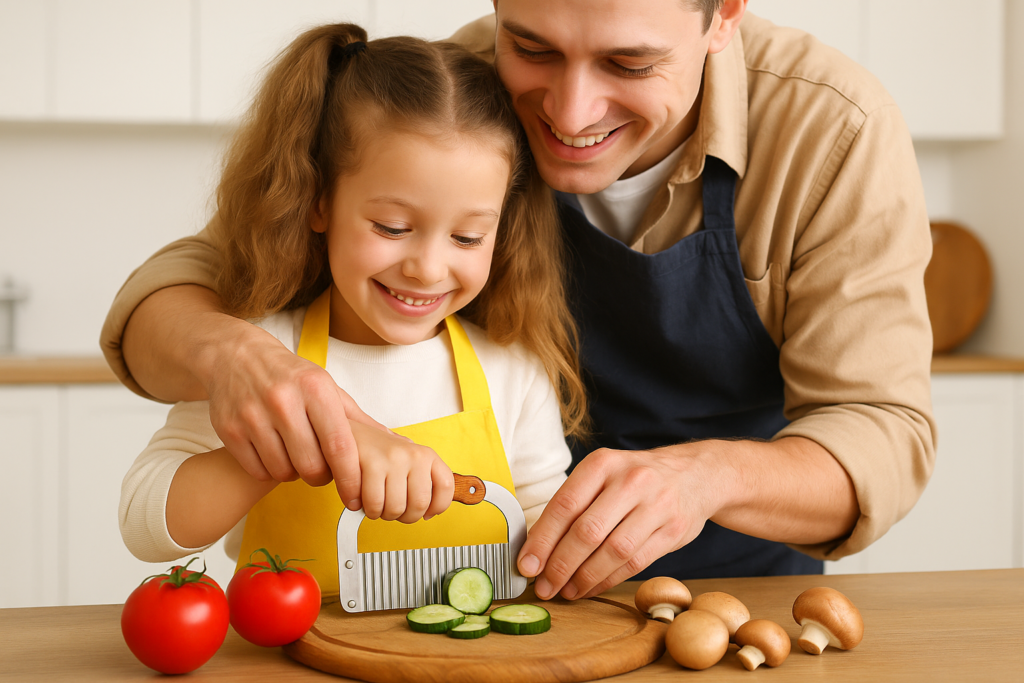
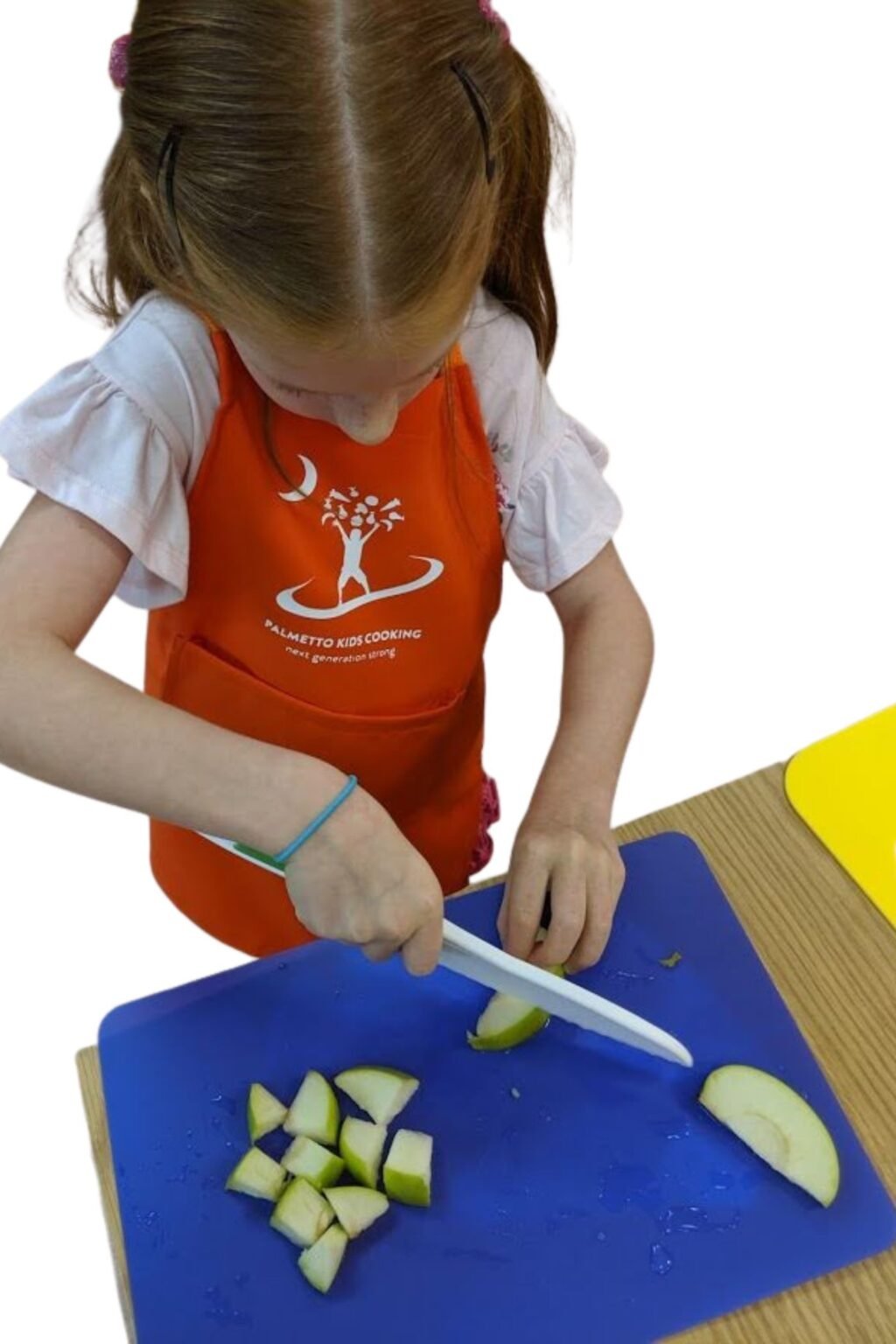
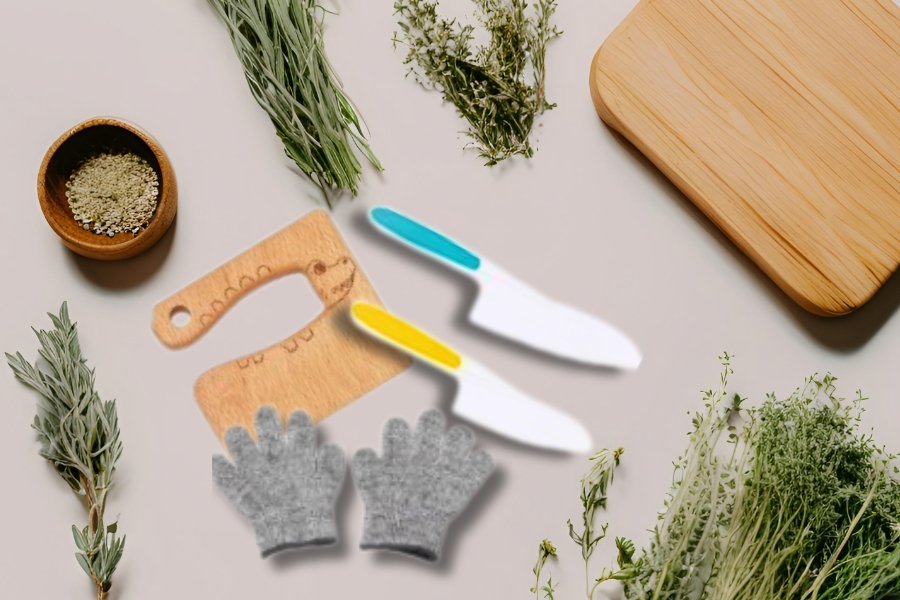
Start with soft foods: bananas, strawberries, and cucumbers. You could even use Play-doh for practice.
Intermediate (Ages 5–8): Transition Knives
Once a child shows consistent body control and hand strength, you can introduce:
- A cut-resistant glove for the guiding hand
- Starter knives with finger guards
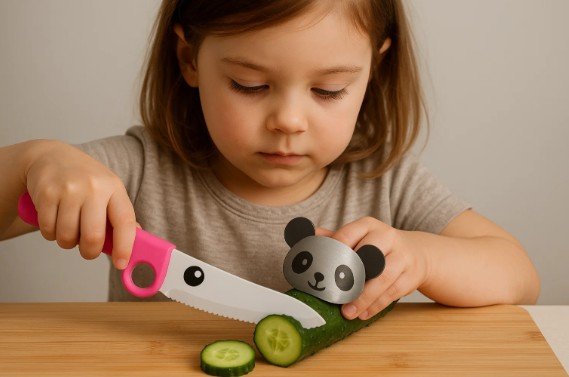
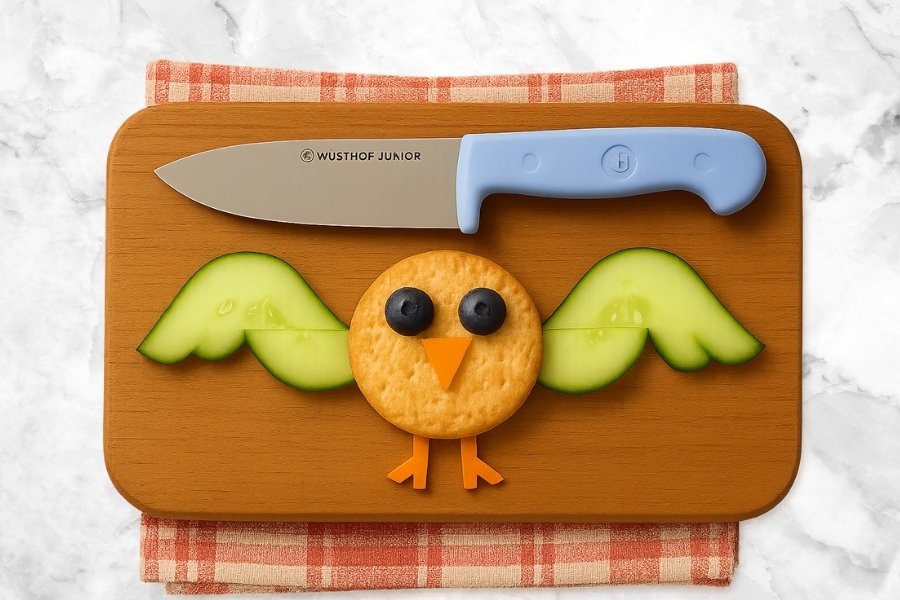
This is the age where parents feel most nervous—but with an appropriate tool, soft food, and close supervision, children can practice while gradually building control.
Advanced Beginner (Ages 8–12): Beginner Chef Knives
An older child who has practiced consistently can use:
- A 4″–6″ beginner chef knife or paring knife
- Non-slip ergonomic handles
- A cut-resistant glove for extra security
At this stage, kids are learning real cooking skills. With guidance they can hone in on techniques like chopping and dicing – julienne and chiffonade can come later.
Essential Tools to Support Safe Cutting
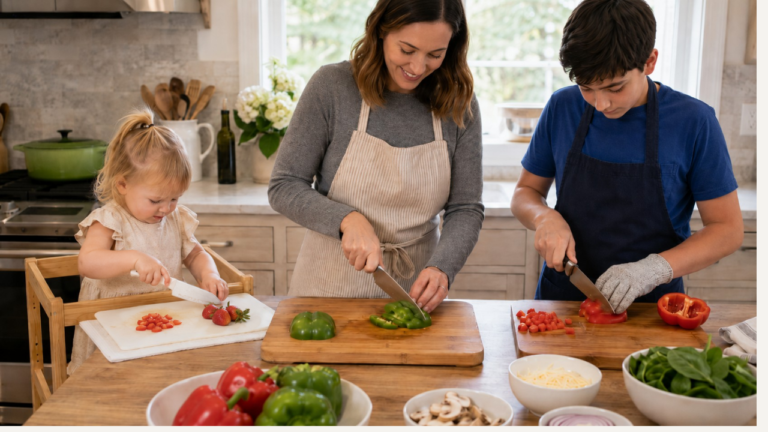
- A learning tower instead of a chair or stool, so your child works at a stable, comfortable counter height next to you
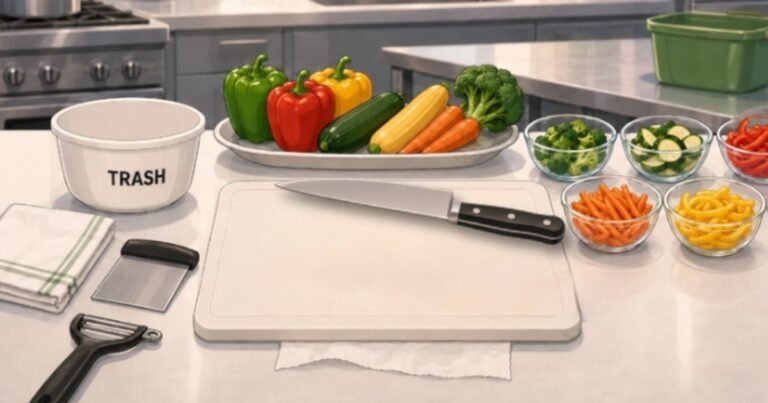
- A non-slip cutting mats or boards (or a damp paper towel or cloth beneath the mat or board to keep it from sliding)
- A cut-resistant glove on the guiding hand
- An easy-grip knife sized for small hands
- Bowls with non-skid bottoms for collecting chopped foods
These tools help eliminate slipping, reaching, and wobbling—the most common sources of accidents. Shop our Kitchen Picks.
Mastering the Knife Is the First Step to Mastering Knife Skills
Grip #1: Handle Grip
- Index, middle, ring, and pinky fingers all wrap the handle
- Guiding hand forms the claw grip
Less control, knife can spin in this grip.
Grip #2: The Pinch Grip
This is the universal professional grip.
- Thumb and index finger pinch the blade
- Remaining fingers wrap the handle
- Wrist stays relaxed
The pinch grip gives the young cook greater control over the blade and less strain, but the child’s hands and knife handle must still be completely dry.

Note: Resting the index finger along the spine of the knife can reduce control and create unnecessary tension in the hand and wrist. Teach the demonstrated pinch grip instead.
Guiding Hand: The Bear Claw Grip
The bear claw grip is the single most important safety habit.
- Fingertips curl inward, so fingernails are face downward
- Knuckles guide the knife as the side of the blade rests lightly against the knuckles with each motion. This sounds wild and scary, but it’s really safer when the two hands work together.
Teach curling fingertips inward first—no exceptions.
Making Your Presence Known In The Kitchen For Safety
Teaching a few simple spoken cues helps a busy kitchen stay accident-free, especially with more than one person working in it:
- “Sharp” — said when moving through the kitchen while holding a knife
- “Behind” — said when moving behind someone
- “Corner” — said when approaching a blind corner
- “Hot” — said when carrying or passing something hot
Designing a Safe & Calm Cutting Environment
Create a space where children can focus without distraction:
- Place a damp cloth or paper towel under the board or mat to keep it from sliding
- Keep knives, mats, and bowls within easy reach
- Turn off distractions like TV and tablets (unless the recipe is on the tablet)
- Use a learning tower so kids work at comfortable, stable height next to you
A calm environment = safer hands = better learning environment.
A Simple First Knife-Skills Lesson
You can introduce knife practice in one short session:
1. Start With a Banana
Soft, predictable, perfect for beginners.
Teach:
- Gentle slicing motion
- Claw grip
- Controlled motion
2. Move to a Cucumber
Soft but firmer—builds a bit more strength and control.
3. Add Strawberries
Helps teach cutting in the middle and laying the flat side down.
4. Try Kiwi or Cheese Sticks
Introduces resistance safely. Remember that whole kiwi can roll. Any round food needs a stable, flat side before the child begins cutting.
5. Finish With a Beginner Recipe
Simple ideas:
- Rainbow fruit salad
- Veggie platter
- Pasta salad
Kids love eating what they chop—it builds ownership and excitement.
Mistakes Parents Commonly Make (and How to Fix Them)
❌ Using dull knives
✔️ If your child is ready for a real knife, use beginner-appropriate sharp knives for clean cuts
❌ Standing too far away
✔️ Stay close enough to guide hands
❌ Rushing the lesson
✔️ Repeat slow motions often
❌ Starting with hard foods
✔️ Begin with soft, forgiving foods
❌ Using too many tools at once
✔️ One knife, one board, one bowl
Beyond Knife Skills
Knife practice builds more than kitchen confidence, which leads to:
- Reading and following recipes
- Math skills (fractions, shapes, portioning)
- Self-regulation
- Independence
- Nutrition awareness
Tip: Kids try more foods when they help prepare them, so if you have a finicky eater this might be an open door.
Why Technique Matters: A Moment I Still Think About
I remember watching a cooking segment where Gordon Ramsay teaches Matthew McConaughey how to plate the steak for presentation. I froze when it was Mr. McConaughey’s turn to cut the steak for his plate. Chef Ramsay reminded him: “Watch your fingers.” I found myself holding my breath, half-expecting to see that razor sharp knife fillet his fingers because they were extended, flat against the steak.
I wonder how many other culinary professionals saw that video and almost passed out. Just me?
All I can say is that in the five years that I taught in-person cooking classes for children ages 3 to 14, I never had an incident during knife practice. The incident involving a cut was after class, and that is covered in my Knife Safety Instructor Guide.
If an experienced chef sees a need to remind another adult to watch his fingers, it is easy to understand why children need repeated instruction before safe hand placement becomes a habit.
Important Safety Practices Every Kitchen Needs
- Never leave sharp tools in a sink of soapy water – including blender and food-processor blades – someone might reach into the water and slice their hand.
- Never pass a knife directly from hand to hand – Lay it flat on a counter instead and let the other person pick up the knife safely. You cannot hand over a knife like a pair of scissors
- Always stabilize the cutting mat with a damp cloth
- When cutting something round, cut it in half and put the flat side on the board– it’s far easier and more stable to cut from there
- When food sticks to the knife, never slide your finger from the handle to the tip of the blade – instead use a downward motion from the top of the blade straight down toward the sharp cutting edge; a better option is to use a bench scraper, spatula, or another appropriate utensil to remove it.
- Never put a knife in a drawer with other utensils – get a knife block, or magnetic strip to put on the wall. The exception is if the knife has a protective sheath you place over the blade
- Always use a sharp knife
Start Every Cooking Lesson with Confidence
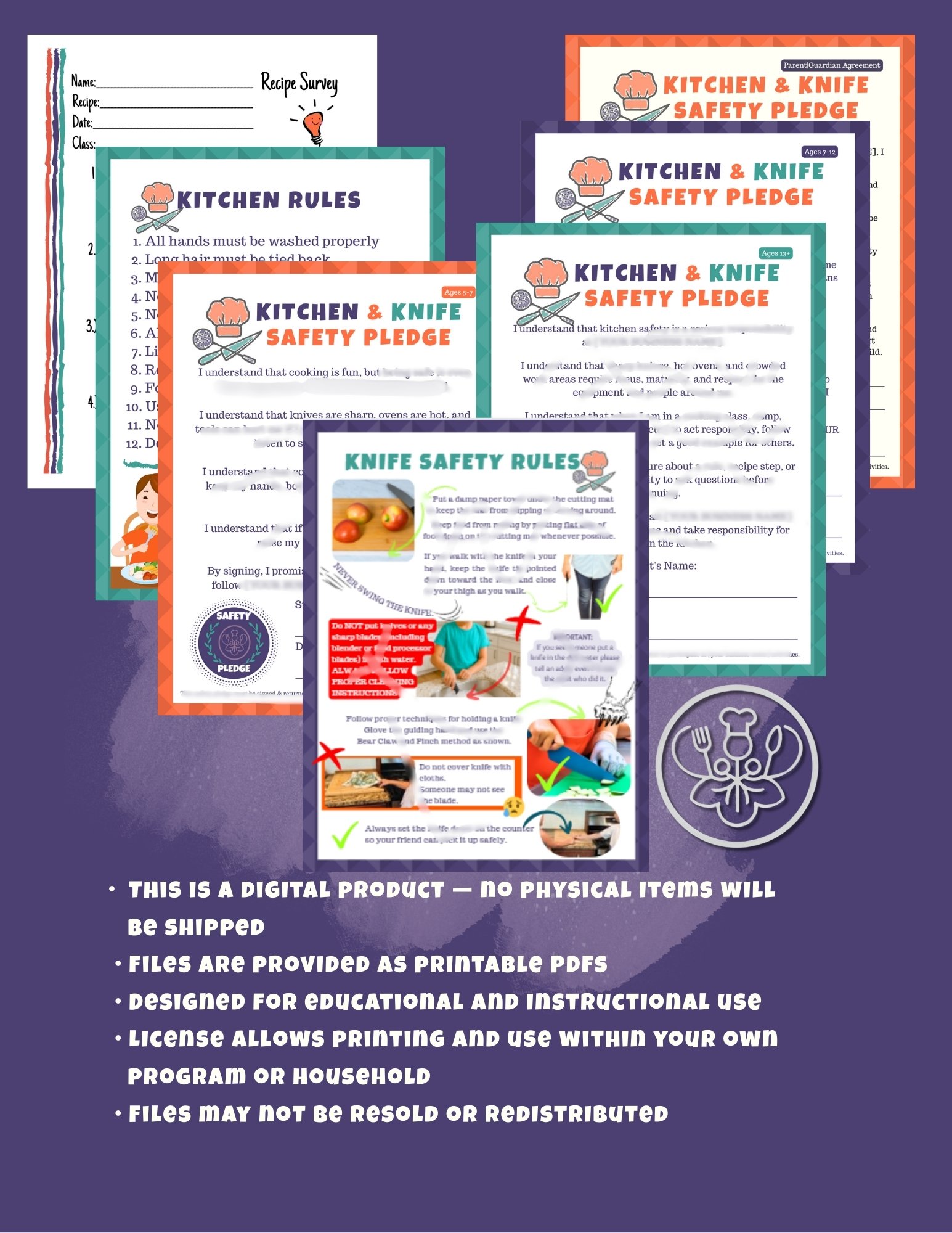
Whether you’re teaching at home, in a classroom, or running a cooking program, safety should never be an afterthought.
My Kitchen Rules & Knife Safety Bundle with Posters provides:
- Clear kitchen and knife safety rules
- Age-appropriate student pledges
- Parent agreement and completion certificate
- A structured approach you can reuse every time
These foundational practices keep everyone safer—kids and adults alike.
Instructor Tips for Group Lessons
If you teach in a homeschool co-op, enrichment program, or your own mobile cooking school:
- Stay close—Close supervision helps reduce the risk of an injury and allows the instructor to stop unsafe behavior immediately.
- If a child uses the knife unsafely, calmly say:
“Please set the knife on the counter.” - Never correct hand position while the child is holding the knife — pause the activity first
- If unsafe behavior continues twice, remove the knife for the day
- When a classroom becomes too chatty, stop talking and raise your index finger. The response should be children stopping and raising an index finger. Don’t talk, and don’t start the lesson again until every child is looking at you with an index finger raised. I learned this from a parapro and it works like a charm. There is no need to raise your voice in cooking class unless it is kitchen communication for safety, or there is an actual emergency.
This keeps emotions regulated and the group calm.
FAQs About Kid Safe Knife Skills
What age can a child start learning knife skills?
Most children can begin practicing on soft food between ages 2–4 using nylon or wavy-edge knives.
Are plastic knives safer than metal knives?
Plastic knives can still cut skin and often require more pressure, leading to unsafe habits. Plastic can snap. If your child has to use the index finger to apply pressure, then it is the wrong knife for the situation. Correct the placement of the index finger because it will cause tension and fatigue in the wrist. No fingers should be straight while handling a knife.
Should my child wear a cut-resistant glove?
A glove on the guiding hand can boost confidence, especially for ages 5–8. I would recommend a cut-resistant glove until the child is confident and you see that dexterity and control warrant a bare hand. In my classes, everyone who was handling a knife wore a glove on their guiding hand, even adults. There is no shame in the extra measure of safety.
How do I know when my child is ready for a metal knife?
When they consistently demonstrate body control, Bear Claw Method and Pinch Grip consistency, and calm movements.
Can knife skills really help picky eaters?
Possibly! It’s worth a try! In my experience it helps because kids are more likely to taste foods they helped prepare. Don’t force it.
Teaching kitchen and knife safety is one of the most empowering lessons in the kitchen. With the right tools, a stable environment, children become confident, capable, and safe in the kitchen—skills they will use for the rest of their lives.
👉 Access the Complete Kitchen & Knife Safety System
👉 Video: Ep. 2 Knife Safety – Teach Kids to Cook – Instructor Series
Brussoni M, Olsen LL, Pike I, Sleet DA. Risky play and children’s safety: balancing priorities for optimal child development. Int J Environ Res Public Health. 2012 Aug 30;9(9):3134-48. doi: 10.3390/ijerph9093134. PMID: 23202675; PMCID: PMC3499858.
Dean M, O’Kane C, Issartel J, McCloat A, Mooney E, Gaul D, Wolfson JA, Lavelle F. Guidelines for designing age-appropriate cooking interventions for children: The development of evidence-based cooking skill recommendations for children, using a multidisciplinary approach. Appetite. 2021 Jun 1;161:105125. doi: 10.1016/j.appet.2021.105125. Epub 2021 Jan 19. PMID: 33482302; PMCID: PMC8609961.