
What Should Kids Learn Before They Use a Kitchen Knife?
There comes a point when a child who loves being in the kitchen no longer wants to be the one who only stirs the bowl.
Kids want to really help.
Maybe the family is getting ready for a holiday meal and there are carrots to slice, celery to chop, apples to prepare, or herbs to cut. Your child is watching everyone else work and asking, “Can I do that?”
For a parent, that can be an exciting—and slightly nerve-racking—moment.
For a cooking instructor, it is a familiar one. Cutting is one of the foundational skills that allows children to move from simply participating in a recipe to actually learning how to cook. But before we teach a child how to make beautiful slices or neat dice, we need to teach the habits that make those skills safer.
Readiness is not determined by age.
A child may be eager to help, but the adult needs to consider maturity, attention, dexterity, hand size, and the ability to follow directions. A child who can listen, work slowly, and stop immediately when asked may be more ready than an older child who is distracted or impulsive.
Whether you are teaching one child at your kitchen counter or a group of young chefs in a class, these are the habits I want children to understand before the cutting begins.
1. Children need to understand that a knife is a tool—not a toy
Before a knife is placed in a child’s hand, establish what the tool is for and how it will be respected.
Cooking with children can be lively. They talk. They tell stories. They get excited when they do something in the kitchen for the first time. They turn around because someone called their name.
That is normal.
But holding a knife changes the expectation.
When a knife is in a child’s hand, their attention needs to stay on the knife and the task in front of them.
One simple rule I like is:
Knife down when you talk.
If a child wants to tell a story, turn around, reach across the counter, or respond to something happening nearby, the knife goes safely onto the cutting board first.
Children don’t automatically make that connection. We have to teach it.
And that is an important part of learning to cook: knowing that different tools require different levels of attention and responsibility.
2. The knife lesson actually begins before the knife comes out
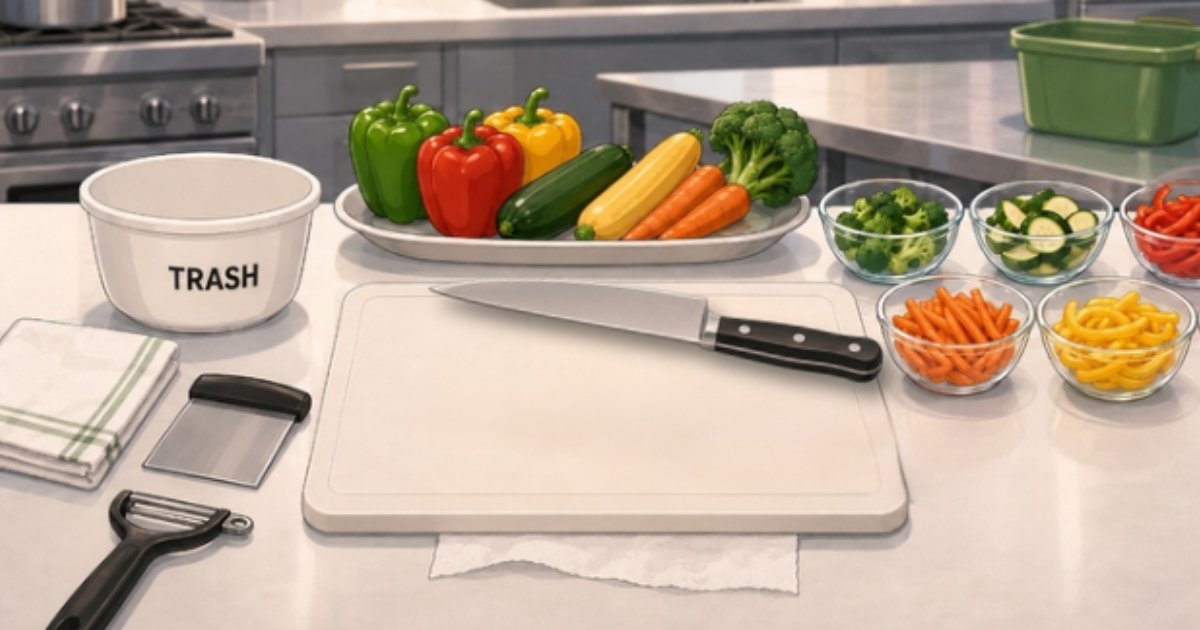
A safe cutting lesson starts with the workspace.
Eventually, children should learn how to prepare their own stations. An organized workspace is part of mise en place—having everything in its place before the cooking begins.
Before cutting:
- Clear away unnecessary objects.
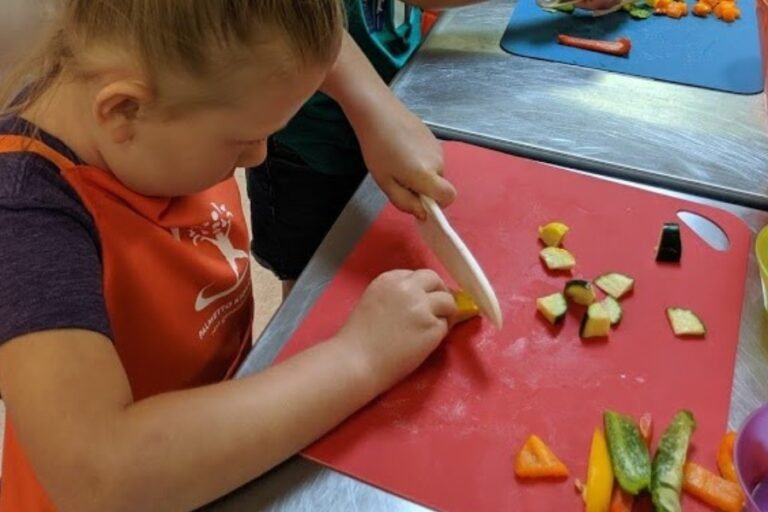
- Secure the cutting board so it cannot slide.
- Place a damp paper towel under a plastic cutting board or use an appropriate non-slip liner under a wooden board.
- Keep a trash bowl nearby for peels, stems, wrappers, and scraps.
- Leave enough room so the child is not bumping elbows with another cook.
- Keep ingredients organized and within reach.
- Remove phones, tablets, and other distractions from the immediate cutting area.
- Make sure the floor and surrounding area are free of slipping and tripping hazards.
A trash bowl may sound like a small detail, but it keeps children from repeatedly walking through a busy kitchen carrying scraps—or carrying a knife while looking for somewhere to put them.
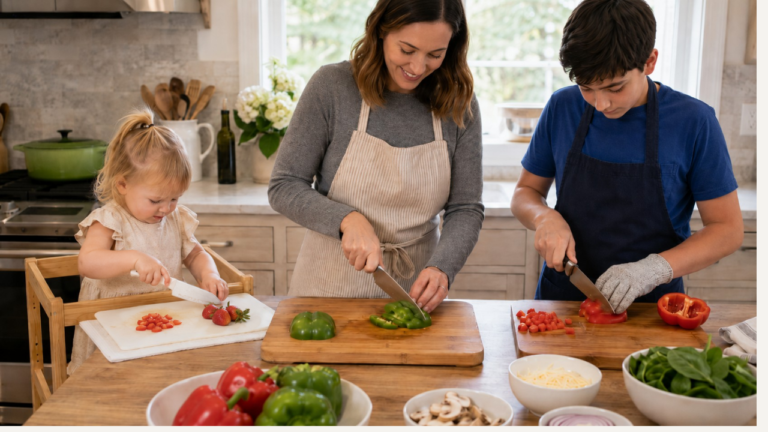
At home, this becomes especially important when several people are preparing a holiday meal at once. Kitchens become crowded. Someone is opening the oven. Someone else is carrying a hot pan. Another person needs the sink.
Giving a child a defined, organized workstation gives them fewer things to manage and gives the supervising adult a much clearer view of what is happening.
3. Choose a knife the child can actually control
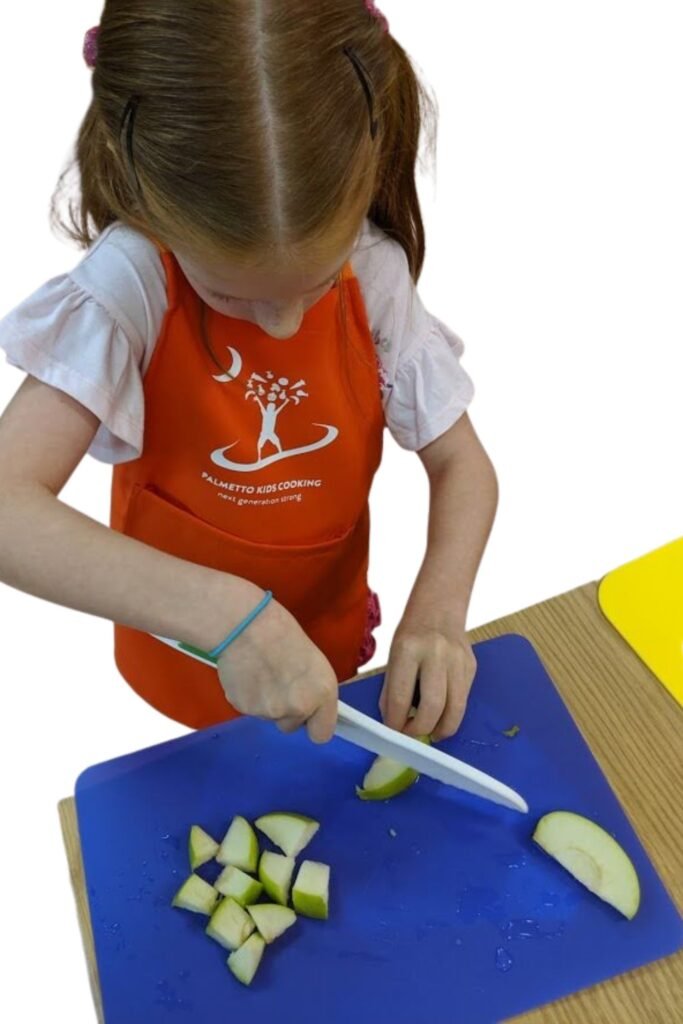
A knife should not be selected simply because the package says “kid-friendly.”
And it should not be selected by age alone.
The tool needs to fit the child’s hand, ability, maturity, and current skill level.
Before beginning the lesson, consider:
- Can the child comfortably use the demonstrated pinch grip without resting the index finger along the top of the blade?
- Is the handle too large or too small for the child’s hand?
- Is the tool appropriate for the food being cut?
- Can the child make the required cutting motion without struggling or forcing the knife?
- Can the child maintain control while listening to instructions?
There is an important difference between challenging a child with a new skill and giving them a tool they physically cannot control.
The goal is not to find the biggest knife a child can manage.
The goal is to choose a tool the child can control well under close adult supervision.
That is also why readiness can look different from one child to another—even when the children are the same age.
4. Look for control before focusing on cutting technique
Before worrying about beautiful slices or perfectly diced vegetables, look for the behaviors that show a child is ready to manage a sharp tool.
Can the child:
- Keep their eyes on the cutting board?
- Maintain a calm body while holding the knife?
- Work slowly instead of rushing to finish?
- Keep both hands where they have been taught to place them?
- Listen while an adult gives instructions?
- Stop immediately when asked?
- Put the knife down before talking, turning, or reaching for something?
These habits matter more than how quickly a child can cut a carrot.
If a distraction occurs, another person comes too close, the workspace becomes crowded, or the child begins losing control, the adult should stop the activity. If the child cannot respond immediately, there is nothing wrong with changing their kitchen job for the day.
Learning to cook is not a race.
There will be another carrot. Safety is what matters.
I demonstrate these and other knife-safety expectations in Episode 2: Knife Safety from my Teach Kids to Cook – Instructor Series. Parents, teachers, camp leaders, and cooking instructors can watch the lesson before introducing knife skills and use the same clear expectations with their young cooks.
5. Teach children how to move safely in a shared kitchen
Ideally, children should not need to walk around while holding a knife. An organized workstation keeps the tools and ingredients they need within reach.
But children also need to know what to do if a knife must be moved from one work area to another.
Teach them to:
- Carry the knife down at their side.
- Keep the sharp edge facing backward and away from the body.
- Say “Sharp” so people nearby know that a knife is being carried.
- Say “Behind” before passing behind another person.
- Walk slowly and keep their attention on where they are going.
- Never run, gesture, or turn suddenly while holding a knife.
In a busy kitchen, people cannot always see what is happening behind them. Calling out “Sharp” and “Behind” gives everyone a chance to stop and make room.
These are the same kinds of clear kitchen calls professional cooks use to prevent collisions around sharp tools, hot pans, and crowded workstations.
6. Never hand a knife directly from one person to another
Children often know the polite way to hand someone scissors: hold the closed blades and offer the handle.
A kitchen knife is different.
Teach children not to transfer a knife directly from one person’s hand to another.
Instead:
- Place the knife flat on a stable surface.
- Move your hand away.
- Let the other person pick it up.
Why?
Because if a knife slips while two people are passing it between them, neither person has a safe way to catch it.
And that leads to another rule worth teaching early:
Never try to catch a falling knife. Step back, keep your hands away, and warn anyone standing nearby.
Putting a knife down before transferring it creates a predictable pause—and predictable habits are valuable in a busy kitchen. We like predictable.
7. Sharp tools should never disappear into sudsy dishwater
Cleanup is part of cooking, which means knife safety doesn’t end after the meal is served.
Never place a knife, grater, peeler, food-processor blade, or other sharp tool underneath cloudy, sudsy dishwater where no one can see it.
A person washing dishes may reach into the sink with no idea that a sharp edge is hidden in the water.
Children should learn from the beginning that sharp tools remain visible during cleanup and that they should ask an adult for help when appropriate to clean them.
This is one of those kitchen rules that seems obvious after someone explains the reason.
Before that?
A child may simply think, “Dirty food-processor blade goes in the sink.”
That is why we teach the why, not just the rule.
8. Protect the guiding hand
The hand holding the food is the hand we need to think about most carefully.
Teach children the bear claw method: fingertips and thumb turn inward while the knuckles help guide the knife.
When children are beginning to use sharper tools, a properly fitted cut-resistant glove can provide an additional layer of protection for the guiding hand.
A cut-resistant glove may also be useful with tools such as:
- knives
- graters
- peelers
- mandolines
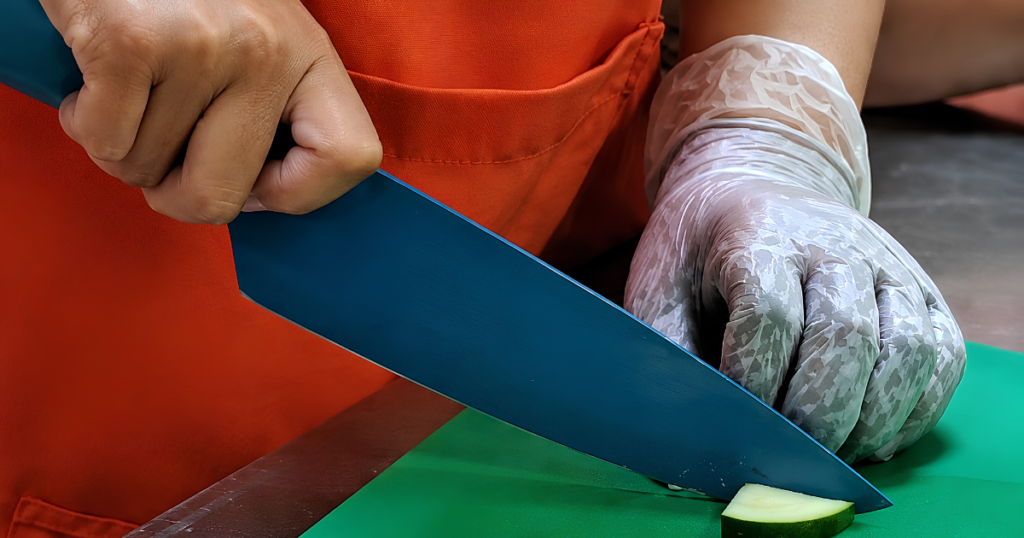
A glove does not replace instruction.
It does not replace the bear claw.
And it certainly does not replace adult supervision.
The purpose is to add another layer of protection while a child is building control and learning where both hands belong.
A cut-resistant glove is not cut-proof, and it should never replace the safety guard supplied with a mandoline or another cutting tool.
9. Dry hands are part of knife safety
This is one lesson I have never forgotten.
In culinary school, one of my instructors showed us a scar that ran the full length of the palm of his dominant hand.
Earlier in his career, he had been working as a chef at an event and cutting meat on a cutting board. The juice from the roast had gotten on his hand.
As he began his break, he followed the professional practice of sliding the blade underneath the cutting board, leaving the handle accessible. But because his hand was slick with juices from the roast, it slipped from the handle and traveled down the sharp edge of the blade.
I instantly made a mental note:
Children need to dry their hands before handling a knife or another sharp tool.
Wet hands make it more difficult to maintain a controlled grip.
If a child’s hands become wet—or the knife handle becomes wet—stop.
Dry both completely before continuing.
The same principle applies to the workstation. Keep the cutting area as dry and stable as possible so the child can concentrate on the skill rather than compensating for preventable slipping hazards.
Sometimes the safety habit a child remembers years later is not a complicated technique.
It’s simply:
Dry hands first.
10. Use a quick readiness check before cutting begins
Before the knife comes out, take a moment to review:
- The workspace is clean, organized, and stable.
- The child understands that a knife is a tool that requires their attention.
- The knife fits the child’s hand and current ability.
- The child can hold and control the knife as demonstrated.
- The child can follow directions and stop immediately when asked.
- The child knows to put the knife down before talking, turning, reaching, or becoming distracted.
- The child knows to place a knife down rather than handing it directly to someone.
- The child knows never to catch a falling knife.
- The child knows that sharp tools never disappear into sudsy dishwater.
- The guiding hand is positioned safely and protected when appropriate.
- The child’s hands and the knife handle are dry.
- A responsible adult is close enough to supervise and step in.
This is not a pass-or-fail test.
It is a way for the adult to identify the habit that needs a little more practice before the child is managing a sharp tool.
What if your child isn’t ready yet?
Not being ready to use a knife does not mean a child isn’t ready to help in the kitchen.
This distinction is especially important in a family kitchen.
When everyone is preparing a special meal, children often aren’t asking for a knife because they are fascinated with knives.
They want to contribute.
So give them a real job.
Depending on their abilities, they can:
- measure ingredients
- mix
- wash produce
- tear lettuce
- remove stems from herbs or baby spinach
- set out ingredients
- set the table
- read recipe steps
- organize the workstation
- carry safe ingredients from one prep area to another
They can also practice the behaviors that will eventually make knife work possible:
Listening.
Stopping when asked.
Keeping the workstation organized.
Staying focused.
Putting a tool down before turning away.
Those are cooking skills too.
There is no benefit in shaming or pressuring a child into using a knife before they are ready. A successful kitchen experience builds confidence—and confidence gives you something to build on the next time they ask, “Can I help?”
Practice before the kitchen gets busy
If you know your child wants to help prepare a holiday meal, the busiest afternoon in the kitchen may not be the best time for their very first knife lesson.
Practice beforehand.
Choose a quiet time when the adult is not simultaneously watching the oven, answering the door, making gravy, and wondering whether someone remembered to thaw something.
Teach mise en place for the workstation.
Practice putting the knife down.
Practice the pinch grip with the knife hand and the bear claw with the guiding hand.
Practice stopping.
Practice cutting something manageable under direct supervision.
Then when the family kitchen becomes busy, the child is not being introduced to five new rules while everyone else is rushing.
For cooking instructors, the same principle applies.
Teach safety before the recipe creates urgency.
That is one reason I like using a short knife-safety lesson before the cooking portion of a class. Children hear the expectations while their attention is still on learning—not while they are impatiently waiting to cut the first strawberry.
The Teach Kids to Cook – Instructor Series was created with that kind of teaching moment in mind.
Watch Episode 2 – Knife Safety
We aren’t teaching children to be afraid of knives
We are teaching them to become mindful in the kitchen and respectful of tools that can cause an injury when safety rules are not followed.
Using a kitchen knife safely isn’t the final goal. It is one of the foundational skills that eventually allows a child to prepare ingredients, follow recipes, make meals, and become more independent in the kitchen.
That independence begins with habits.
A prepared workstation.
A tool the child can control.
Dry hands.
A protected guiding hand.
The ability to stop.
And an adult who is willing to teach the same expectations consistently instead of assuming children already know them.
A child who isn’t ready today can still help today.
And a child who learns these habits patiently has something much more valuable than permission to hold a knife.
They are beginning to gain confidence in the kitchen.
For families, teachers, camps, and cooking programs that want visual reminders of these expectations, the Kitchen Rules & Knife Safety Bundle provides additional materials that can stay visible while children work.
Have fun, and stay safe in the kitchen!
Ready to give your child a safe start in the kitchen?
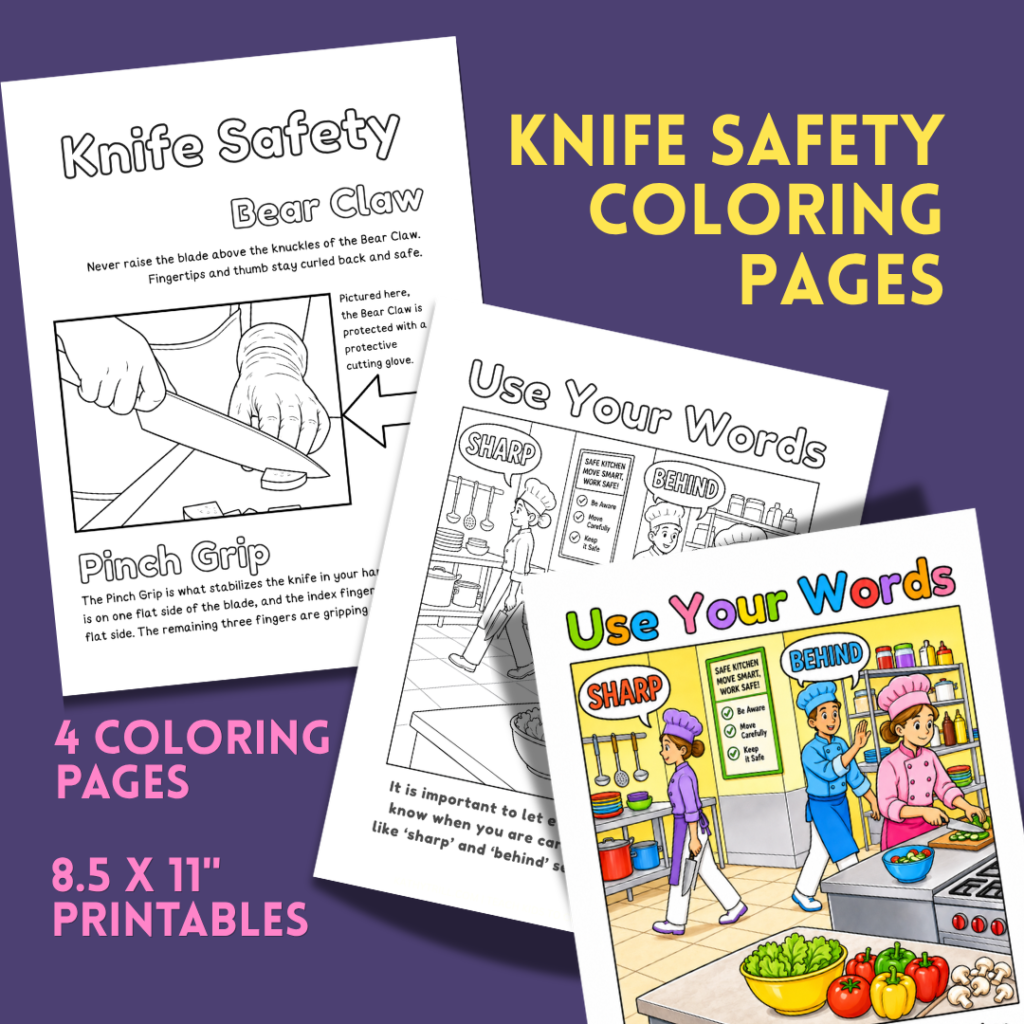
Before children begin practicing knife skills, they need to understand the safety rules that protect them. Download my free Knife Safety Companion Coloring Pages for a kid-friendly way to begin the conversation.

One Comment